
My experiences as a wildlife videographer
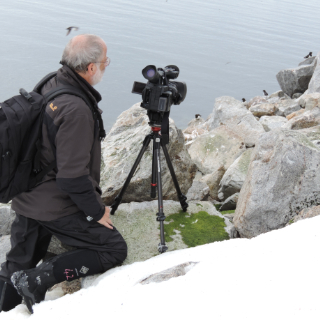
In 1998, after more than 25 years devoted to naturalistic photography, I was loaned a video camera.
The virus was inoculated and, despite the difficulties inherent in computer editing 24 years ago, hours of shooting, first in 4:3, then in 16:9 filled giga, then terabytes on several hard drives.
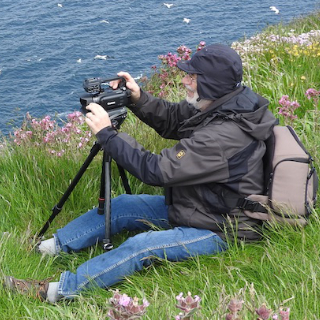
The idea here is to talk about the means available to the amateur to create videos of animals filmed in nature. We are very, very far from the means of professionals, as at the BBC.
We are talking about cameras costing a few thousand Euros and a hobby taken on leisure hours or holidays.
Professionals spend days in places that are sometimes very difficult to access, with equipment that costs an arm and a leg. For example, the BBC sent two filmmakers for four months to Antarctica to film the reproduction of penguins with cameras costing 90,000 Euros, not counting the lenses, the viewfinder and other pieces.
We will therefore remain modest and limit ourselves to the basis of shooting and editing digital videos.
We quickly forget that the first PC montages were made in a quarter-frame VHS1, and that, shortly after, the calculation of a one-second fade in SD definition took up to a minute. Then, with HD, and now 4K, image quality has changed considerably, but this requires powerful computers and considerable storage space.
In the following pages, I propose to describe how I proceed to film wild species and produce short - or less short - montages visible on a TV screen or on the web. It will therefore be a question of shooting hardware, editing software and work on image and sound.
I propose to divide the subject into three parts:
General considerations on shooting >>>
Then the work on the sound >>>
And finally the improvement of the images >>>
1 Some technical considerations:
As a reminder, the VHS format is, in principle, 720×576 pixels. A quarter of VHS therefore consists of 360×288 pixel images. Not really exceptional.
The appearance of the mini-DV format, also 720×576 pixels, but rectangular equivalent to a 768×576 square pixel image was a real progress. It was followed by HDV, 1440×1080 rectangular pixels equivalent to the 1920×1080 of HD format, but slightly less sharp than real HD.
Finally, the cameras abandoning cassettes for SD cards, we arrive at real HD - 1920×1080 pixels, then 4k, quadrupling the number of pixels to 3840×2160... thus quadrupling the times for calculating effects and transitions.
 English
  French